

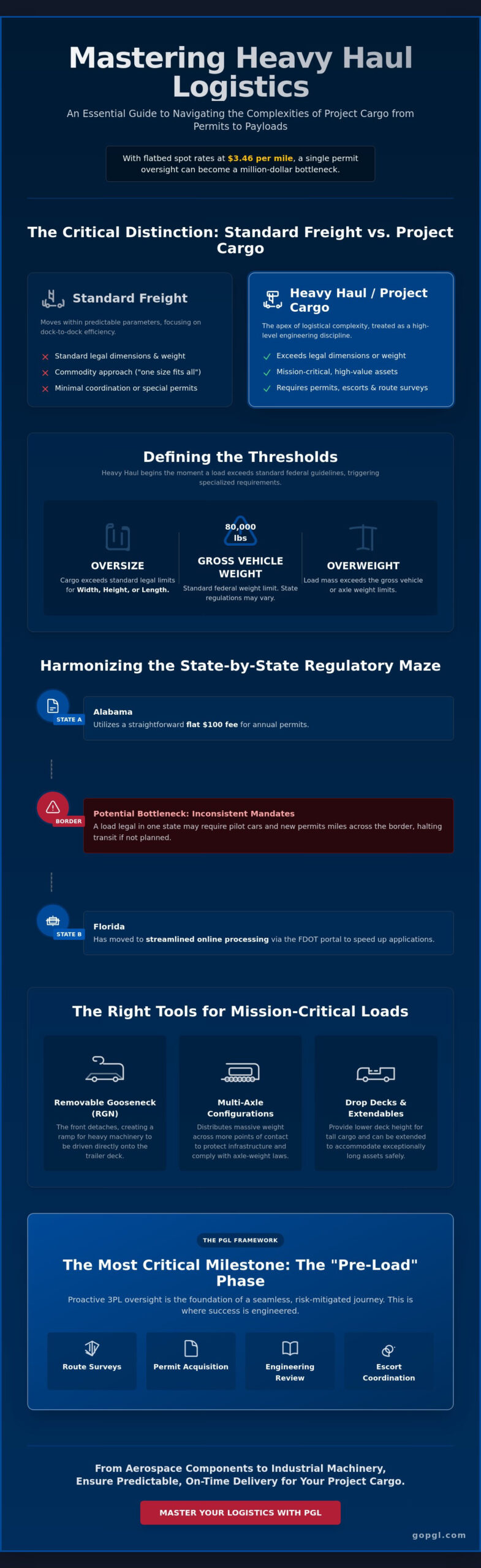
If you treat heavy haul as a standard trucking commodity, you’re likely one permit oversight away from a million-dollar bottleneck. In a market where flatbed spot rates have surged to $3.46 per mile as of May 2026, the margin for error has never been thinner. You already recognize that transporting high-value aerospace components or oversized industrial machinery requires more than just a trailer; it demands a sophisticated engineering and regulatory strategy. Successfully managing heavy haul transport services means balancing diverse state-level mandates and evolving digital permit requirements, while maintaining the absolute safety of your most sensitive assets.
It’s frustrating when unforeseen delays at state borders or a lack of visibility into multi-modal transitions threaten your project timelines. This guide empowers you to master these complexities by providing an authoritative roadmap to regulatory compliance and strategic project cargo management. We will examine the critical equipment standards for 2026, the nuances of state-level permitting, and the proactive 3PL oversight required to ensure a seamless, risk-mitigated journey from origin to destination.
Key Takeaways
- Distinguish between standard freight and mission-critical cargo by identifying the specific escort and permit requirements that define oversized logistics.
- Understand how strategic 3PL oversight provides the end-to-end visibility and coordination necessary to manage high-stakes heavy haul transport services without friction.
- Learn why the “Pre-Load” phase serves as the most critical milestone in a methodical framework for executing complex, multi-modal transport projects.
- Discover how to navigate multi-state regulatory hurdles by framing compliance as a stabilizing force that ensures predictable delivery timelines.
- Gain specialized insights into managing the unique logistical pressures of the aerospace industry, including integrated strategies for time-critical project cargo.
What are Heavy Haul Transport Services?
Heavy haul transport services represent the apex of logistical complexity. Unlike standard freight that moves within predictable parameters, heavy haul involves cargo that defies standard legal dimensions or weight limits. This isn’t just about size; it’s about the mission-critical nature of the assets involved. When you’re moving a multi-million dollar turbine or a sensitive aerospace fuselage, the stakes are too high for a “one size fits all” approach. These operations require a shift in perspective from simple transportation to a high-level engineering discipline.
The distinction between standard trucking and heavy haul is absolute. While a standard carrier focuses on dock-to-dock efficiency, a Heavy hauler must navigate a landscape of state-specific permits, pilot cars, and rigorous route surveys. We categorize these high-stakes movements as Project Cargo. This strategic subset of logistics treats every move as a unique project, ensuring that every variable is accounted for long before the cargo is ever loaded. It is a proactive method of removing friction from the supply chain and ensuring total reliability for industrial leaders.
Understanding Legal Limits and Over-Dimensional Thresholds
Federal guidelines generally cap gross vehicle weight at 80,000 pounds, but the transition into heavy haul territory happens the moment a load exceeds these limits or standard dimensions. It’s vital to distinguish between “Oversize,” which refers to physical dimensions like width and height, and “Overweight,” which refers to the actual mass of the load. These thresholds are not uniform across the country. Each state manages its own permitting process and fee structures. For example, a load that is legal in one jurisdiction might require a specialized escort vehicle just miles across the border. This regulatory fragmentation makes centralized coordination essential for any national transit plan.
The Role of Specialized Equipment in Heavy Lift Operations
Precision in heavy haul transport services relies on highly specialized hardware tailored to the specific geometry of the load. Removable Gooseneck (RGN) trailers are the industry standard for heavy industrial machinery because the front detaches, allowing equipment to be driven directly onto the deck. For exceptionally heavy loads, multi-axle configurations are mandatory. These systems distribute the massive weight across more points of contact with the road, preventing damage to infrastructure and ensuring compliance with axle-weight regulations. We also utilize drop decks for tall loads and extendable trailers for cargo that exceeds standard length, providing the stability and clearance required for a seamless delivery.
Navigating the Regulatory and Technical Complexity of Heavy Loads
Regulatory compliance shouldn’t be viewed as a bureaucratic bottleneck. Instead, it’s a stabilizing force that protects your mission-critical assets from legal and physical risk. Effective heavy haul transport services rely on a deep understanding of Federal oversize/overweight permit regulations, which establish the framework for state-level enforcement. Without this strategic oversight, a project can quickly derail due to inconsistent state mandates or technical oversights that lead to costly delays. We view these regulations as the blueprint for a secure, predictable journey.
Executing a national transit plan requires an expert ability to harmonize conflicting state rules. For instance, as of May 2026, Alabama utilizes a flat $100 fee for annual permits, while Connecticut relies on complex weight-based formulas. Florida has recently moved toward online processing through the FDOT portal to streamline applications, yet other states maintain traditional filing methods. Managing these discrepancies is vital to avoid permit expiration or route conflicts that can halt a shipment at a state border. For the most complex requirements, our Project Cargo specialists ensure that every administrative detail is synchronized with the physical movement of the goods.
Permit Acquisition and State-by-State Coordination
The complexity of permit acquisition grows exponentially with the size of the load. Superload permits, which cover cargo exceeding standard oversize thresholds, often require lead times of several weeks for engineering reviews, compared to the few days needed for standard permits. Strategic planning prevents the risk of permit expiration, which can occur if unforeseen weather or mechanical issues delay the transit beyond the permit’s valid window. We synchronize these timelines across multiple jurisdictions to maintain continuous forward motion.
The Science of the Route Survey
A successful haul begins long before the wheels turn. The route survey is a physical verification process where specialists drive the intended path to document every bridge height, low-hanging wire, and tight turn. Technology plays a vital role here; pole cars utilize physical or electronic sensors to ensure vertical clearance for tall equipment. This proactive measure mitigates the primary risk of heavy lift operations: unforeseen physical obstructions that could compromise the integrity of high-value aerospace or industrial components.
Beyond simple route planning, heavy haul transport services require rigorous engineering calculations. We must analyze bridge weight tolerances and turn radii to ensure that multi-axle trailers can safely navigate specific infrastructure without causing damage. Safety escorts, including private pilot cars and official police details, provide an essential layer of protection. They manage traffic flow and provide real-time feedback to the driver, transforming a high-stakes move into a methodical, risk-mitigated operation.
Choosing a Partner: Asset-Based vs. Strategic 3PL Oversight
Why not simply hire a specialized trucking company? It’s a common question for project managers facing the pressure of mission-critical timelines. While an asset-based carrier provides the physical equipment, a strategic 3PL acts as an Authoritative Global Navigator, managing the entire ecosystem of your supply chain. Heavy haul transport services aren’t just about the truck; they’re about the choreography of movement. A strategic partner provides the high-level oversight necessary to manage multi-modal transitions, international customs brokerage, and complex regulatory landscapes that a single-mode carrier simply isn’t equipped to handle.
Choosing a strategic ally means gaining end-to-end visibility into every milestone of your project. For high-value aerospace assets, this includes specialized White Glove Delivery that goes beyond standard transport. We treat your cargo with the precision it deserves, ensuring that sensitive components are handled with tailored care from the moment they leave the factory floor until they’re installed. This level of coordination is essential for maintaining predictable delivery timelines in a volatile market where flatbed spot rates have reached $3.46 per mile as of May 2026. The American Trucking Associations (ATA) consistently emphasizes that safety and regulatory adherence are the cornerstones of a reliable transport network, a philosophy we integrate into every project cargo plan.
The Advantage of Multi-Modal Integration
Complex industrial projects rarely exist in a vacuum. Often, the most efficient route involves a combination of ground transportation, ocean freight, or international air freight. We manage the high-stakes transload points where cargo shifts between modes, removing the friction that typically leads to damage or delays. By consolidating these services under a single point of contact, you reduce the risk of communication gaps and ensure that your mission-critical cargo moves through a seamless, integrated chain.
Risk Management and Insurance for High-Value Assets
Standard cargo insurance is often insufficient for the multi-million dollar components common in the aerospace and energy sectors. We provide specialized high-value coverage tailored to the specific risks of heavy lift operations. Our proactive approach to risk management includes:
- Rigorous Carrier Vetting: We only partner with carriers who meet stringent safety and reliability benchmarks.
- Real-Time Tracking: Advanced analytics provide stakeholders with constant visibility into the cargo’s location and status.
- Loss Prevention: Methodical pre-load inspections and securement protocols minimize the risk of damage during transit.
This comprehensive strategy ensures that even the most complex heavy haul transport services are executed with total reliability and peace of mind.
A Step-by-Step Framework for Executing a Heavy Haul Project
Success in heavy haul transport services is won or lost in the boardroom and the engineering office long before the engine starts. We view every movement as a methodical sequence of high-stakes milestones where the margin for error is non-existent. While many logistics providers focus solely on the transit phase, we recognize that the ‘Pre-Load’ phase is the most critical for ensuring total reliability. As your Authoritative Global Navigator, we guide you through a rigorous framework designed to remove friction and eliminate the variables that cause costly delays. This process requires intense coordination between shippers, receivers, and the logistics team to ensure everyone’s synchronized on the project’s technical requirements.
Phase 1: Engineering and Site Assessment
Site assessments are non-negotiable. We conduct thorough surveys at both the origin and destination to verify loading space, overhead clearances, and soil stability for heavy lift operations. Will a standard crane suffice, or do we need specialized rigging for a 100,000-pound industrial turbine? We answer these questions by finalizing technical drawings and weight distribution plans that account for every inch of the cargo’s geometry. This engineering-first approach ensures that the physical execution aligns perfectly with regulatory requirements and equipment capabilities. By addressing these technical hurdles early, we provide the proactive reassurance that mission-critical projects demand.
Phase 2: Execution and Real-Time Visibility
Once the plan is set, execution requires White Glove Delivery precision to protect your high-value assets. We manage the loading process with an intense focus on the structural integrity of high-value aerospace and industrial components. During transit, we maintain constant communication between the driver, safety escorts, and our centralized command center. We don’t just hope for clear roads; we use advanced analytics to monitor weather patterns and road-related disruptions in real-time, allowing us to adjust the route proactively. This level of coordination transforms complex heavy haul transport services into a predictable, managed outcome. It’s about maintaining stability in a fast-moving industry.
To ensure your next mission-critical move is managed with this level of strategic oversight, explore our comprehensive Project Cargo solutions.
The PGL Edge: Integrated Solutions for Aerospace and Industry
PGL acts as the stabilizing force for the world’s most complex supply chains. While many providers view heavy haul as an isolated trucking task, we see it as a critical component of an integrated logistics strategy. We remove the friction from high-stakes transportation by synchronizing heavy haul transport services with our broader suite of capabilities, including customs brokerage and contract logistics. This holistic oversight ensures that your cargo doesn’t just move; it arrives with the precision that mission-critical industrial projects demand. Our approach transforms a fragmented process into a unified, risk-mitigated operation.
Tailored Solutions for Aerospace and Time-Critical Needs
Aerospace components are often fragile and exceptionally high-value. Moving a massive engine or a fuselage section requires a Time-Critical mindset. We apply the same urgency found in AOG (Aircraft on Ground) situations to our heavy haul projects. As a Strategic Ally, we solve the complex logistics puzzles that arise when oversized cargo meets tight delivery windows. This specialized expertise in aerospace ensures that your most sensitive assets are handled with the highest level of technical care, regardless of the shipment’s scale. We prioritize stability and speed to keep your operations in motion.
Global Reach with Seamless Domestic Execution
Our ability to support national domestic moves is strengthened by a global strategic perspective. We provide more than just ground transportation; we offer fully integrated warehousing and distribution solutions to facilitate project cargo staging and inventory management. Whether your project involves domestic air freight for smaller components or ocean freight for massive machinery, we maintain total visibility across the entire chain. We are the Authoritative Global Navigator you need to simplify complexity and maintain momentum. To ensure your operations remain uninterrupted and your timelines remain predictable, Contact PGL to optimize your next heavy haul project.
Mastering the Logistics of Scale and Precision
High-stakes projects require more than just specialized equipment; they demand a stabilizing force capable of navigating a fragmented regulatory and technical landscape. You’ve seen how meticulous engineering and proactive route surveys transform potential bottlenecks into a predictable, methodical flow. By integrating multi-modal solutions with specialized customs brokerage, you can move oversized industrial assets across borders without the friction that typically stalls less sophisticated operations. This strategic approach ensures that complexity is managed before it ever impacts your timeline.
The intricacies of heavy haul transport services are best mastered through a partnership built on aerospace-grade logistics expertise and end-to-end visibility. We provide the strategic oversight needed to ensure every milestone is met with total reliability, acting as your global navigator to remove risk from the equation. Whether you’re moving time-critical aerospace components or massive industrial machinery, our team is dedicated to your operational success. Ready to secure the stability your mission-critical cargo deserves? Request a Strategic Consultation for Your Heavy Haul Project and ensure your next move is executed with absolute precision and compliance.
Frequently Asked Questions
What qualifies as a heavy haul shipment?
A shipment qualifies as heavy haul when its dimensions or weight exceed the standard legal limits set by federal and state authorities. This typically includes gross vehicle weights over 80,000 pounds or cargo that surpasses standard width and height thresholds. Because these parameters vary by jurisdiction, any load requiring specialized permits or escort vehicles to move safely on public roads falls under the category of heavy haul transport services.
How much lead time is required for an oversized transport project?
Lead times for oversized projects depend on the technical complexity and the number of states the route crosses. While standard permits might be secured in a few business days, “superloads” often require several weeks of advance coordination. This window allows for essential engineering reviews, route surveys, and the scheduling of police escorts. Proactive planning ensures that these administrative requirements don’t disrupt your time-critical project milestones.
Do heavy haul services include the cost of permits and escorts?
Professional logistics providers typically bundle the costs of permits and pilot cars into their strategic project quotes for maximum transparency. These expenses are calculated during the pre-load phase based on the specific route and current state-level fee structures. While some carriers might treat these as pass-through costs, a strategic partner integrates them into a seamless transport plan to remove the financial friction associated with multi-state coordination.
Can heavy haul cargo be transported internationally?
Heavy haul cargo can be moved globally through integrated multi-modal solutions that combine ground transportation with ocean or air freight. This process requires sophisticated coordination at transload points and expert customs brokerage to manage international regulatory requirements. By utilizing a partner with a global strategic perspective, you can ensure that even the largest industrial components move seamlessly across international borders while maintaining total visibility and safety.
What is the difference between an oversized load and a superload?
An oversized load exceeds standard legal dimensions, whereas a superload surpasses much higher thresholds that trigger mandatory engineering and infrastructure reviews. Superloads are often characterized by extreme weight or dimensions that require specialized multi-axle configurations to protect road surfaces and bridges. Because of the increased risk to infrastructure, superloads demand a higher level of scrutiny, including physical route verification and specific law enforcement escorts.
How do route surveys prevent delays in heavy haul transport?
Route surveys prevent delays by physically verifying that the intended path is free of obstructions like low bridges, utility lines, or narrow turns. A specialist drives the route to confirm that the theoretical plan aligns with the physical reality of the infrastructure. This proactive measure eliminates the risk of a shipment being halted mid-transit, ensuring that your mission-critical timelines for industrial or aerospace projects remain secure and predictable.
What specialized trailers are used for heavy haul services?
Specialized trailers like Removable Goosenecks (RGNs) and multi-axle systems are the foundation of reliable heavy haul transport services. RGNs allow for the efficient loading of heavy machinery, while multi-axle configurations are essential for distributing massive weight to meet axle-load regulations. Other tools, such as drop decks for tall cargo and extendable trailers for long assets, are selected based on the specific geometry and weight of the project cargo.
Is insurance included in heavy haul transport quotes?
Standard carrier liability is included in most quotes, but high-value industrial assets often require supplemental coverage tailored to the specific risks of the project. Because aerospace and energy components frequently exceed standard policy limits, we recommend a customized insurance strategy to protect your investment. A strategic ally will help you assess these requirements during the planning phase, providing the proactive reassurance and protection that high-stakes projects demand.
RELATED POSTS
The Engine Market Is Evolving — Logistics Must Evolve...
Publised: February 26, 2026
The Engine Market Is Evolving — Logistics Must Evolve With It The global engine market is undergoing one of the most significant shifts in recent memory. Demand for engine maintenance […]
PGL Video Newsletter – January 2026
Publised: February 11, 2026
January at PGL: New Programs, New Momentum January marked a strong start to the year at Perimeter Global Logistics, with new program launches, new customer resources, and continued momentum across […]
OTB BOOTS Case Study: Supply Chain and Fulfillment
Publised: February 10, 2026
OTB BOOTS CASE STUDY PGL EMPOWERS OTB BOOTS’ LAUNCH WITH SCALABLE FULFILLMENT EXCELLENCE In the competitive world of footwear brands, OTB Boots realized quickly that logistics can’t be an afterthought. […]